Sunday, 9 January 2011

Quintessentially English

Scott Ulla
Countryside Affairs
by Scott Ullah

Published in European Socialist Action No 31

I am currently enjoying my well earned day off and have just got back from a lovely walk at the local wildlife sanctuary. I didn’t spot anything unusual apart from two ripe Porcini mushrooms that I will cook with some garlic and cream and have it on toast for my lunch. We are all guilty, from time to time, of taking nature reserves and wildlife sanctuaries for granted and readily assume they are there for our enjoyment as of a public right. I often visit them for that essential connection with nature and, inwardly, I am better for it. The mushrooms were delicious, by the way. Better than the supermarket’s.
However, I am disturbed to learn that this Coalition government will include natural conservation areas in its austerity measures. Disturbed, because some of the most beautiful areas could be sold off like everything else the Tories and their willing accomplices, the Liberal Democrats, deem ripe for privatisation and, therefore, exploitation for private profit. It is all in the interests of reducing our national deficit, they tell us.
Spending cuts are most likely to hit ‘Green England’ soon with proposals including selling off our beloved nature reserves and privatising the Forestry Commission. Over 2,000 miles of our canals and waterways will have all their grants removed, the consequences of which can only be detrimental to our environment and our enjoyment of it. The Environment Agency is going to be forced to reduce spending on such things as pollution and waste controls, spelling disaster for the biology of our waterways.
We are bound by very strict environmental measures from the European Union, measures that are still in force and will cost us further in terms of fines and other penalties. For example, there are strict EU Commission conservation regulations regarding wild birds and habitats. New marine nature reserves will suffer as well. The British government has legal obligations under European Union directives but it seems William Hague’s threat that the Coalition will not play ball with Europe over certain areas of our national life is to be casually realised ... but definitely NOT in the interests of our treasured environment, its wildlife and the preservation of everything else that makes England’s natural areas so wonderful.
What is the sense in depriving the natural environment of preservation and protection for the purpose of cutting our deficit when, on the other hand, such actions will only bring about enormous financial penalties?
The Coalition Environment Secretary is Caroline Spelman. She has already decided on the abolition of thirty environmental advisory groups which includes the Royal Commission on Environmental Pollution. The damage predicted will set back environmental progress by at least forty years. Spelman backs the growing of genetically modified crops (Frankenstein foods) and backs the culling of badgers in England even though they are protected in law.
When you really think about it, the threat to our environment and, thus, the well-being of all the people in these isles does not come principally from ‘climate change’ but from an irresponsible government whose sole agenda is to attack the weakest and most vulnerable elements in our land. Unnerved that the public sector is not going to stand for any attacks upon its people, this government turns its sights on an important element that has no trade union power to defend it against cuts. That is the craven cowardly purpose behind hacking away at the resources of our natural reservations and the environment in general. It can not answer back!
The consequences will be disastrous. 25 conservation groups addressed the government with a statement saying, these measures “could have profound and perhaps irreversible consequences for wildlife, landscapes and people .... a false economy — short-term savings would translate into huge long-term costs for our economy and our well-being”.
Those who signed the statement included The Royal Society for the Protection of Birds, the Campaign to Protect Rural England and several others.
It said, “Reed beds are dry and clogged with brambles; heath lands have vanished as scrubs begin to take over. Wetlands have dwindled and rivers and canals have become clogged by invasive plants which threaten native species. The loss of money for wildlife-friendly farming has seen farmland birds resume their slide into extinction.
Bat populations are clinging on to survival in isolated pockets, facing starvation due to the dwindling insect populations, while the country’s flower meadows have all but vanished. England’s uplands have become degraded; their wildlife is in decline and their ability to lock away carbon and provide clean drinking water for millions sadly reduced.
There are fewer people, too. Without cash to keep paths and bridleways open, huge swathes of the English countryside and coast are effectively closed to millions”.
Ahmed Djoghlaf, Secretary General of October’s United Nations Convention on Biological Diversity, summed up the threat with, “It would be very short-sighted to cut biodiversity spending. You may well save a few pounds now but you will lose billions later. Biodiversity is your natural asset. The more you lose it, the more you lose your cultural assets, too”.
To think that such near-criminal destruction is carried out in the interests of delivering sacrificial offerings into the gaping hole of the god of international banking, in order to appease it, is unspeakably obscene. This government, a coalition of Tory millionaires and well-healed Lib Dems, is prepared to destroy our natural heritage, a heritage that belongs to the people but soon to become another statistic in the bankers’ racket of debt-creation on a massive scale.
This Coalition government is not a product of the people’s will. It has no mandate nor any moral justification for destroying our natural conservation areas. It is the product of an illegitimate arrangement between two minority parties hungry for power. Well, they are not in power for any altruistic reasons, are they? They are not there for the purpose of improving our lives. More like improving their lives, that is for sure.
The next time I pick some Porcini mushrooms I must wonder how much longer I can do this.

Wednesday, 17 November 2010

Quintessentially English

Celebrating English Rural Culture
 

by Scott Ullah

Published in European Socialist Action No 30, September/October 2010
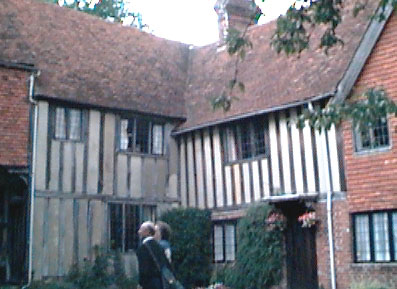
(above right, Penshurst Place)

To find a village in the South East of England that epitomises the perfect example of English social life, in terms of rank and quality, was always going to be a time consuming challenge for me so it was an idea that I immediately put to bed. I decided to focus on searching for the best preserved country pubs.

Picture this, a cosy and inviting pub with its dark wooden-beamed interior, open fireplace and friendly staff who only serve well kept, local real ale. This was an image that was conjured up in my mind when I first decided to search for the ‘holy grail’ of the English village pub, the unmistakable centre of traditional village social life.

Over the next few issues I would like to share with you some of my best and worst experiences in pursuit of that mission, of finding the most quintessentially English hostelry and maybe reveal to you some of the many hidden gems that I have found along the way.
I decided to start my search by visiting a village nestled in the ‘weald’* of the Kent countryside, not far from Royal Tunbridge Wells. Penshurst is a village rich with history. Previously occupied by the Saxons until the Norman invasion of 1066, Penshurst stands beside the vast and well kept grounds of Penshurst Place manor.

The manor, which is home to one of the finest examples of Fourteenth Century domestic architecture, is well worth a visit if you have the time, before tasting the liquid delights that the local pubs have to offer. After leaving the long and repetitive road of the A21, I was left to navigate my car through the narrow, winding, secluded roads of The Weald. It’s funny but this kind of road always reminds me of those typical American horror movies where the guy breaks down in the middle of ‘Deliverance’ country, only to be hunted down by a pack of inbred, deformed scavengers.

This, of course, did not happen to me and the only sign of human life that passed by me was an old man sitting on a fence staring at a flock of sheep that were grazing lazily in a field. Much more civilised! But all is not well despite the idyllic stillness.

The English countryside is under threat from development with Government proposals to meet fresh housing targets initiated under a Labour government. The new Coalition government intends to relax planning rules further. All these beautiful villages I love so much, where the weary traveller will find hospitality and refreshment, are to be engulfed by vast new housing developments, changing forever the landscape and the character of historic areas like the Weald.

One of my favourite causes is the Weald of Kent Protection Society whose fiftieth anniversary falls this year. Its events calendar reads like a rustic community’s traditional fare from a Wealden Ploughman's Lunch, an annual Summer Party, to volunteers for making log piles in Cole Wood (a 12 acre semi-ancient wood dominated by sycamore with ash, oak and beech supporting a mixed vegetative community left to the Society). Inviolable and so precious.

The Weald of Kent Protection Society exists for one of the noblest causes you will find in this England of ours — to resist the urbanisation of the Weald and to preserve the green belt for posterity. In their own words: “The society’s aim is now, and always has been, to protect and enhance the rural character of our Wealden villages and countryside”.

As I sat out the back of The Spotted Dog in Penshurst sipping their finest ale, I viewed the Weald as far as the eye could see. It is wondrous as you feel its ancient presence, a legacy handed down for all to enjoy and, most of all, to respect.

I am a great believer in rural communities maintaining a certain continuity, forever close to the land from generation to generation. They are the custodians of the land in the same way as the old established peasant families were on the continent of Europe before the Second World War, now sadly replaced by an industrialisation of agriculture. It began elsewhere with Stalinist brutality and the elimination of the Kulaks in Russia.

I fear the encroachment of urban sprawl, the lifting of planning regulation, opening up to the very great dangers of the spoiling of traditional English beauty and it will be devastating.
Even for the outsider, the ‘townie’, our rural areas are a source of escape from the greyness of our concrete towns, from the modernism of new office blocks and the asphalt of roads and supermarket car parks. Go into the countryside, as I do, for the very clear purpose of enjoying it for what it is and what it should always be — a contrast to our urban life and not an extension of it.

Ah, yes. I come back to my traditional village pub as a centre of local life. In early evening there is a buzz as it fills with the residents of the area, all of them knowing each other, greeting and smiling to those so familiar to them. These pubs have not been ‘themed’.
I am an outsider, a visitor, and I must extend the same friendly gestures because it is the most natural thing to do. This familiarity is a characteristic of rural life that is very noticeably disappearing in our towns and cities where community has been so eroded over the years. It is called society and being social, sadly gone completely in some places.

The Weald of Kent Preservation Society is exactly that in spirit and in practice. Preservation societies are motivated by the best reasons whatever their interests. We must consider everything that is beneficial to the well-being of the nation and look after it as a shepherd minds his flock. Such a rural metaphor is more than appropriate — it should be an everlasting symbol of what is undoubtedly a great responsibility.                                     Scott Ullah

Friday, 27 August 2010

Traitors Were Never Patriots

Alfred Vivian Minchin in German uniform
by Robert Edwards

Published in European Socialist Action No 29, July/August 2010

With war inevitable on September 1, 1939, Sir Oswald Mosley, the leader of British Union, issued this statement to all members of his organisation: “To our members my message is plain and clear. Our country is involved in war. Therefore I ask you to do nothing to injure our country OR TO HELP ANY OTHER POWER. Our members should do what the law requires of them and, if they are members of any forces or services of the Crown, they should obey their orders and, in particular, obey the rules of their service ... We have said a hundred times that if the life of Britain were threatened we would fight again ...”. In May 1940, he wrote, “... Stories concerning the invasion of Britain are being circulated ... in such an event every member of British Union would be at the disposal of the nation. Every one of us would resist the foreign invader with all that is in us...”.

John Amery was never a member of British Union or any similar organisation although, along with William Joyce, he came to personify that type of misguided idealist, adopting the ideological ethos of another country. In that sense, they had something in common with the Burgesses and Macleans of the post-war world.
All the countries occupied by the Germans in the Second World War were, de facto, under German martial law, defeated and without their former heads of government. For them, hostilities had ceased and life seemed to continue more or less as in peace-time. Without directions from their former heads of government, the inhabitants of the occupied territories had several choices ...collaboration, neutrality or resistance. With the absence of a state of war, collaboration seemed the most realistic course for many. Others volunteered for the Waffen SS divisions in defence of the New Order.
Britain, however, remained at war throughout the duration and for its citizens the moral question was far simpler. The duty of a patriot was to fight in the defence of Britain, whether the war was right or wrong. This was the position of Oswald Mosley and British Union, even though many were interned without charge or trial under Defence Regulation 18b. Many other Mosley men, however, made the supreme sacrifice in all the branches of the armed forces. In this respect, Mosley’s Blackshirts were patriotic to a man, while a handful of traitors had left the movement long before hostilities commenced. William Joyce being one and a notable exception as far as British fascism was concerned.
John Amery was a strange case, indeed. From a wealthy family, his father was Leo Amery ... a member of Churchill’s Cabinet and a drafter of the Balfour Declaration, then becoming the Secretary of State for India and Burma. His younger brother, Julian, became a not inconspicuous Tory MP after the war and paid dearly for his sibling’s ultimate fate on the gallows. He loved his brother and wished eternally that things had been different.
Leo sent his eldest son to public school where he excelled himself with his first act of notoriety by running off to France with his father’s wallet and a revolver. Thereafter, the father arranged private tuition and John discovered the deceptive sexual delights of prostitutes ... the more the merrier!
As a consequence of this particular peccadillo, his first wife, Una Wing, was an ex-prostitute with several convictions for plying her trade in the West End of the capital. When funds were really short, John was not averse to turning to being a rent boy himself on several occasions.
After bankruptcy, John Amery was sent to France with a small allowance and from there he dabbled in the far-right movements prevalent at the time.
The Vichy government, anxious then to please both the French people and the Germans, prevented him from leaving France. At the same time, Vichy disapproved of Amery’s adopted style of French radical fascist views. He was an embarrassment to them.
With little else to do, John Amery approached the German Armistice Commission in Grenoble with an offer it seemed it could not refuse. Amery, always one to grasp an opportunity when it came along, was soon to end up in wartime Berlin, speaking eloquently into the propaganda microphones of the Reichsrundfunk, the first foolish move he had made in a long time. On November 19, 1942, John Amery spoke through the Germans’ English language service with material supplied by Dr Fritz Hesse of the England Committee and Joachim von Ribbentrop, the Foreign Minister and former Ambassador to Britain. His broadcast was an immediate flop and he failed to impress anyone, including his listening father who was mortified. His broadcasts continued for several months but he never quite achieved the notoriety of William Joyce.
Even so, he was given the five-star treatment in a luxury hotel with a generous expense account while the Joyces made do with their small apartment and a basic salary.
Amery’s next mission was to tour the internment camps to give tedious homilies on how sensible it would be to change sides and wear the uniform of the enemy. Thus was born the idea of The Legion of St George, later to be known as the British Free Corps, under the control of the SS. It was formed in the last year of the war and numbered no more than thirty misfits out of hundreds of thousands of British prisoners of war. To the annoyance of Joyce, a few had been recruited from his broadcasting assistants.
The types who joined included the son of a Lithuanian Jewish merchant settled in England, a chemist who had been a member of British Union from 1934 to 1938, the son of a German immigrant who had found himself caught up in the Channel Islands working for the Todt organisation and another, a seventeen year old captured from a torpedoed ship and recruited by Amery, who the lad thought was Britain’s Foreign Minister. Another seventeen year old captured in the Italian campaign thought the British Free Corps was composed of several divisions. As pointed out before, those few who had connections with British Union had lapsed from membership years before the outbreak of hostilities.
This motley crew spent most of their days in indolent debauchery until, after the bombing of Dresden in February 1945, they were ordered to the Russian Front. For all the high-faluting propaganda of fighting Bolshevism, the very purpose of the BFC’s existence, they refused to budge with the Germans placing some blame on them for the bombing of Dresden and then throwing them into prison ... or punishment camp. Two months later, after much pleading, they were released conditionally but always in a state of near rebellion. The rest of the BFC disintegrated in panic at the news of the punishment camps where, it was rumoured, starving prisoners fell on the cadavers of others, pulling out their livers and kidneys for sustenance. One of them, the BFC’s British-born, half-German commandant, Thomas Haller Cooper, walked away to be captured by the British ... later reprieved after being given the death sentence.
Cooper was an exception among his BFC ‘comrades’ because, having a German mother, he had joined the Leibstandarte Division of the Waffen SS soon after the outbreak of war, serving in Poland and Russia, where he was wounded. Parentage sometimes lands the thinking man on difficult shores.
The myth that the British Free Corps represented all the best and noble in the struggle against communism and that they even fell fighting in the ruins of Berlin is the stuff of pulp fiction of the It Happened Here genre. It was never like that. If they had behaved with the gallantry of the various Waffen SS divisions from the occupied territories then there may have been some cause for redemption. Their legal status was one of traitors while their country was at war and no lies or myths can change that fact.
John Amery did not don the field-grey uniform with the British Free Corps cuff band and the Union flag sleeve motif, even though the Legion of St George (later the BFC) was his brainchild. He did more than these (literally) turncoats by touring the camps and inciting British POWs to commit treason. Many former Blackshirts within the ranks of those prisoners must have seethed with contempt for this spoiled, upper-class opportunist who continued his playboy lifestyle when German civilians picked through the rubble of their cities.
He was awarded a gallantry medal after a Berlin air raid but the circumstances remain unknown.
He travelled the length and breadth of occupied Europe, convinced he was a major celebrity, giving speeches to all who would listen ... rather like the present-day lecture circuits. As the war began to draw to a close, he ended up working for Mussolini in Northern Italy.
As befitting his celebrity status, on capture he was escorted into custody by an Intelligence Corps captain by the name of Alan Whicker, not knowing that his captor would, in the years following Amery’s execution, enjoy a rather more successful career in broadcasting than Amery’s ever was.
While Joyce’s council argued the business over a British passport in order to avoid a meeting with the hangman, Amery pleaded guilty on all counts knowing full well that he would receive the death penalty. The Germans, in defeat, passed over all the information they had on him.
The legacy of all this is that a new Europe can only be built on the firm rock of patriotism, each man loyal to his locality, while serving the greater union. The legend printed inside every Union Movement membership card read; BRITAIN FIRST IN EUROPE A NATION. It is the principle to which we subscribe up to this day.
John Amery was a traitor as much as a German who assisted the Allies, for whatever high moral reason at the time. One is bound by an oath of loyalty to one’s country ... always! Otherwise ‘patriotism’ is an empty word.

Wednesday, 5 May 2010

We Are European Socialists

by Robert Edwards (European Socialist Action No 27)

Since the internationalist Labour Party ditched socialism in the form of Clause Four of its constitution (the people should own the means of production, distribution and exchange) for another internationalism, that of global capitalism, then the need today for a revived form of true socialism has never been so evident. It is the only antidote to the creeping encroachment of world capitalism and the possession of the world’s resources into ever increasingly fewer hands.
Socialism has taken many forms over the last hundred years or so, a subject that does not require much elaboration here. We need only think of Hitler and Stalin, to name just two. Used for good or bad, its appeal has always been one for social justice and support for the oppressed. Comparisons with the teachings of Christ have sometimes been applied to it.
Socialism as a generic term, however, has led to its use and abuse to such an extent that definitions seem boundless, sometimes depending on the intensity of class hatred, and ultimately leading to distortions of various kinds. The far-Left has always been a caricature of that disturbing phenomenon.
Oswald Mosley first adopted the phrase European Socialism in a speech to Union Movement on May Day in 1950, two years after the founding of the Movement. It is not so surprising given his earlier career within the Labour Party of Ramsay MacDonald when he sought to apply ‘socialistic ideas’ to curing the great problem of mass unemployment in Britain. He took those ideas with him into the New Party and then into the British Union of Fascists. He later remarked when being interviewed by James Mossman on a BBC Panorama programme in 1968 that, “I exhausted every means in the Labour Party of getting my policies accepted before I left. First of all, the Parliamentary Party; secondly the Conference. And not until I was rejected and defeated in every attempt to get the Labour Party to accept it did I go over with precisely the same policy — and this is so curious — and start the fascist movement. Having been denounced as the wild man of the Left by Snowden and others, I was then supposed to become a right-wing reactionary. But my policy was precisely the same”.
To Mosley, true socialism meant doing something for the people but especially for the good, honest working man. At the core is the idea of syndicalism as the alternative to the bureaucratic nationalisation of the old Labour Party, which, in reality, was simply the transfer of control from private hands into the hands of state bosses ... the workers having no direct say in the running of their industries, whatsoever. Syndicalism means workers’ ownership, a completely different type of ‘socialism’ in its unique form of industrial democracy, whereby the workers control their own means of production. Is not owning the means of production one part of the classical definition of socialism? Do we not represent that principle in its purest form, more so than the international socialists who had so long subscribed to ideas of bureaucratic state control?
Mosley proposed a synthesis of syndicalism and private enterprise which meant reconciling apparent opposites for very practical purposes. The creative individual is encouraged to contribute and to be rewarded for his endeavours. When a man or woman first creates a company or industry, it is left unhindered and encouraged to grow. However, when it reaches a certain size it is regarded as ready for syndicalisation. The original creator of the enterprise is rewarded generously for his past efforts. The spirit of service to the nation is paramount for this to work effectively.
European Socialism is very different to the old International Socialism in that ours has a solid and richer foundation on which to build. The expression National European alludes to the dimension while European Socialism is the creed. They are essentially two aspects of a single idea.
We reject, completely, the idea of an international proletariat, which is the basis of several strands of far-Left thinking ... principally that of Trotskyism. Rather, we understand the importance of kinship and culture within the European family of peoples and on that we can build our own form of socialism far removed from far-Left internationalism and notions of ‘the brotherhood of man’, which would reduce us to the level of economic units without soul.
We recognise cultural differences between peoples which should be respected with all the means for encouraging their development, preserving their roots and celebrating their existence. We have a European culture for which only complete unity can guarantee its survival in the globalist morass that currently surrounds us.
Class war divides a people and can only lead to social fragmentation, harmful to any nation. That is why we reject all theories of Marxian ‘historical class struggle’ and their deterministic ‘inevitability’. Mosley was a pragmatist and not a dogmatist. That is why he insisted on European Socialism being flexible enough to meet all circumstances for purely practical purposes. He was a technocrat who wanted to make things work.
By the 1960s, Mosley stopped to reflect on the term ‘European Socialism’ in his book, Mosley - Right or Wrong (Lion Books 1961). In answer to the question, what is ‘European Socialism’, he replied, “Any man has a right to call himself a socialist if he works for motives of public service rather than for private gain. That is why we used this phrase. Because our people have certainly proved that they work selflessly for the public good and it is this spirit which is needed for the building of a new European system. But I am not going to use it in future because it has led to misunderstanding. British people in general think that socialism means the nationalisation or bureaucratic control of industry, that it means the Labour Party policy which was a concept of the last century [nineteenth century]. But Union Movement has never stood for anything of this kind”.
Many of my comrades in European Action want to re-adopt the phrase European Socialism and for them they have always been European Socialists in the way Mosley first intended it to be used. What we need to do is continue where others left off, defining and redefining this great idea while maintaining core principles, that is to say, truly socialist principles.
Our use of the term is even more relevant today because what were once mainstream socialist parties of the Left, throughout the world, have since abandoned any pretence at being ‘for the workers’ but have all sold out to global capitalism. New Labour is the best example of this in Britain. Every one of them has adopted the principles of what is now talked of as the ‘global economy’ — international capitalism and predatory Finance, ruining the lives of millions within a system wide open to exploitation and unfair competition.
These parties have abandoned the people and now serve a global banking system, causing enormous pain and suffering everywhere you look.
Here is a new opportunity to explain our position very clearly in direct contrast to the sham that is the party political system of the old order of things.
The only other groups that continue to use the socialist label are of the far-Left ... groups that pursue causes such as anti-fascism. In fact, they now call themselves ‘anti-fascist’ before even considering raising the standard of socialism. Mainly Trotskyist (the Stalinist communists are miniscule and factionalist and no longer relevant without the Soviet Union), they are a mirror-image of global capitalism in that they do not recognise frontiers, cultures, races and religions but want a ‘rational’ world economy with all men as mere economic units. This is why many of the neo-cons in the United States, pursuing a policy of global imperialism on behalf of the World Bank, were once Trotskyites in their student days. The goal is the same — the domination of the globe, meaning the complete subservience of all mankind. That is not a conspiracy theory but a conspiracy fact!
We, however, offer the only viable alternative to rule by Money and the perpetuation of an international exploitative way of conducting the affairs of the world. We want the people to be free to run their own lives within their own economic area. But more than that, we want the people to have their own identity as European workers, producing for themselves within a self-contained area large enough to be self-sufficient.
This is the only way you can realise that concept of the people owning the means of production, distribution and exchange, the only way you can have socialism in the way Mosley first understood that term all those years ago.
After the Conference of Venice in 1962, Union Movement adopted the slogan, ‘We Are National Europeans’, emblazoned on the propaganda boards at meetings in Trafalgar Square. In fact, we are both National Europeans and European Socialists — not only interchangeable terms but each to be used according to the context in which they are used.
We should also consider the advantages of any misunderstandings caused by the use of the term European Socialist. If this causes confusion for some then we have the golden opportunity for explaining ... over and over again, if necessary. This is an essential part of the propaganda war and we should hammer it home with all the faith and confidence we possess. It would also serve to draw attention to ourselves, which we desire.
The first point to be made is that we are neither left nor right. European Socialism transcends the old dichotomy of an out-dated parliamentary system based on the seating arrangements of the elected assembly convened after the French Revolution. We want a new democracy without an out-dated party political system that is now exposed so clearly today as a ‘gentlemen’s club’ full of hot air and bad wind, regulating themselves privileges in the form of exorbitant expenses claims, with several Members now being pursued under the Theft Act. Why not nick the rest of these scoundrels and throw them out? Did someone say we need another Cromwell?
It all goes to show that our wonderfully democratic politicians are only out for themselves, each riding on the back of a political party little different to the party next to them. That is why we oppose this party political system and not because we want to do away with them in order to set up a dictatorship. No, we want to return democratic values and principles to the people in order that the people rule and not the political parties, which only follow their own agenda. The alternative to this pseudo-democratic plutocracy is a system of representation known as Occupational Franchise. This is very easy to understand with the briefest of explanations.
In place of the old political parties, we would have an elected House comprised entirely of Members representing trades, professions, women (for example) and various social and economic groupings. You elect a candidate that will represent your occupation. He represents you as an essential part of society and not a party machine. No political party, of left or right, can do this because the party has its own priorities which consist entirely of securing its survival in an infantile game of point scoring — if one jumps up to say the earth is round then his opposite number must jump up and pronounce it flat. This silliness goes on and on with every issue and point of policy. Farmyard impressions abound. The purpose of the ‘opposition’ is to con the people and give the impression that something important is going on when, in fact, it is played out according to an old boy’s tradition going back to the days when only the upper crust could sit. Then, it was truly a privileged club when the rules were created by its Members with complete impunity. It seems the old days are returning and never was a change to the system more needed with leadership restored because we have no true leadership, only mediocrity and politicians that speak like bank managers and with as much passion and conviction as the contents of a bucket of plankton.
Oswald Mosley and others led the way with a great alternative:
For example, point six of the European Declaration agreed at Venice in1962, stated, “That industries already nationalised will be better conducted by workers’ ownership or syndicalism than by state bureaucracy, but the system of the wage-price mechanism will, in full development, make irrelevant the question of the ownership of industry by reason of the decisive leadership of elected government, and will bring such prosperity that workers will have no interest in controversies which belong to the Nineteenth Century”.
This was to be part of a future system agreed on by brother Europeans, part of a new Europe that will one day sweep away all the decay and corruption.

Wednesday, 31 March 2010

Religions Can Live Together

From editorial in issue No 27 by Robert Edwards

When religious affairs in Britain are used as a political football then surely some of us have regressed in terms of civilisation.
For centuries, Christians, Muslims and Jews lived peaceably together in parts of the world now troubled by the war plans of American neo-cons. The hawkish attitude of Israel, with its Zionist doctrine of Jewish supremacism, seems certain to exacerbate the difficulties, not only in the Middle and Far East but here in Europe, as well.
Nick Griffin continues to use his one and only political playing card, that of the perceived threat of Islamisation, yet another newly constructed buzz word in the ‘nationalist’ lexicon, although still not yet entered into the Oxford Concise Dictionary. Not only is it not a legitimate word but its continued use by a bunch of illegitimate thugs with little else on their election stall, calls for some serious comment from us.
Let us take a look at these Islamophobes, a term that accurately describes their mental condition ... fear of Islam. The difference? Islamophobes do exist whereas ‘Islamisation’ is a product of their imagination ... an imaginary nightmare world calculated to scare the delicate among us.
The BNP has been coerced, albeit by law, to adopt a multi-ethnic membership policy and one of its first ‘ethnics’ is an excommunicated Sikh by the name of Rajinder Singh (right). Although born a Sikh in the Punjab, he no longer sports the obligatory beard and his turban is brought out only for photo opportunity shoots. In short, he is a phoney.
The Sikh community has sent him to Coventry and created in him a minority of one. Griffin had placed all his chips on Rajinder Singh bringing all other Sikhs in Britain onto the side of the BNP in the mistaken belief that they all hate Muslims with the same rabid intensity as ‘good old Rajinder’ (Griffin’s hatred of Muslims is purely venal). As such, Rajinder becomes the BNP’s first ‘ethnic’, now in complete isolation and very lonely. He will end up as an albatross around their necks, the curse of the Muslim-hater rejected by his own community and now of no use at all to anyone else.
Can you see the patriotic lads from Dagenham or Burnley giving him three loud cheers as he froths at the mouth, telling them how he would like all Muslims snuffed out? Can you really see them embracing him as one of their own? No, they will revert to type and eventually kick him out. They treat Sikhs with as equal contempt as they do Muslims. To them, they are all ‘rag heads’.
Over in the land of the clogs and tulips we have an even more bizarre Islamophobe. The flamboyant, platinum blond Geert Wilders of the Dutch Freedom Party has come out with what he calls “a rational deterrent to radical Islamists bent on using weapons of mass destruction against America and the West”. He wants to drop a nuclear bomb on Mecca. I am not surprised to learn that the English Defence League endorses Wilders’ mad proposal as many on the English Defence League’s forum have echoed the same.
There used to be a regular feature in Private Eye magazine under the moniker of ‘A Taxi Driver Writes’ and it always ended with “hanging’s too good for them”. Essex Man behind a wheel.
Comments on the EDL forum (in response to Wilders’ proposal) include the Neanderthal-speak, “Nuke em all thats [sic] what I say” and “I say the only way we will find out what will happen is to give it a try”. So much for ‘only against Islamic extremism’.
A few details regarding Geert Wilders need airing here. He regularly visits Israel and considers it his ‘second home’. He also regularly visits the Israeli Embassy in the Netherlands. We can only conclude that, with such unsavoury connections, murdering millions of innocent civilians will come as second nature to him.
Without the poison from these Islamophobes, we could all live in the tolerant spirit of civil and religious liberty ... a very English tradition since 1689. This was the case in the old Yugoslavia until Serbian nationalism reared its ugly head and embarked on ‘ethnic cleansing’, for which one of its main protagonists is now on trial in The Hague.
People professing different faiths can live together in peace and harmony, so necessary for stability within a Europe a Nation of the future. A new Age of Tolerance would ensure that. In the meantime, we need to stand up to and expose the hate-mongers ... those dupes doing the dirty work of the Zionist neo-cons in what is largely an invented ‘war on terrorism’ serving the interests of the globalists based in Washington and Tel Aviv.

Saturday, 6 March 2010

European Socialism, Syndicalism ...
“Viva España!”

by Jeffrey Wallder

Published in European Socialist Action No 26

General Franco certainly saved Spain from the Reds and fifty years of Stalinist oppression. But as Mosley said in private before the war, “Franco wasn’t a real fascist”. A nationalist yes but a socialist never. Once he was in power the big landowners continued to own the land and the industrialists continued to own the factories. The stock exchanges of Spain remained open and life was hard and hungry until the post-war tourist boom brought some relief.
Spain’s real Man of Destiny was Jose Antonio Primo de Rivera, founder and leader of the Falange. This charismatic aristocrat pledged himself to the service of the working people and put forward a blueprint for the complete reorganisation of economic life based on a Spanish version of syndicalism. This involved the re-distribution of power and profit directly among those employed in each factory, farm and retail enterprise.
The cause of worker ownership, against communism, against capitalism, was almost brought to an end in 1936 by the murder by Reds of Jose Antonio in the Spanish Civil War. Franco then assumed the mantle of Caudillo or Leader of the Falange, and began to purge it of the syndicalist element beginning with Jose Antonio’s deputy. Although the Spanish economy was reorganised after the Civil War to give a semblance of syndical structure, power remained firmly in the same old hands.
However, among the blue-shirted rank and file members of the Falange Espanola y de Nacional Sindicalista there was a faction that remembered the original syndical ideals of Jose Antonio and knew that they and their fathers had fought for a better Spain than this.

Mondragon establishes Worker Ownership
in post-War Spain

During the late 1940s and 1950s, Oswald Mosley and Raven Thomson developed a policy of ‘European Socialism’ which applied syndicalist principles to the post-war world. Although Mosley and Raven visited Spain several times during this period, there is no evidence to suggest that they were in contact with the founding members of the Mondragon Corporation which began establishing worker-owned businesses in Spain at about the same time. But the thinking behind the two groups is remarkably similar.
In 1956, five graduates from the Basque region set up Spain’s first syndicalist enterprise making oil-fired heaters and cookers. From its earliest days, Mondragon has been run by a Congress voted to power directly by the workforce. This body then elects an executive council charged with the day-to-day management of the Corporation.
Each Mondragon business also has a Work Place Council that elects a president to work alongside a company manager. Both president and directors are elected on a ‘One Worker, One Vote’ principle.
If the business prospers, the workers benefit directly - but if there is no profit they receive no dividend, only their basic wage. In the event of a company experiencing financial difficulties, Mondragon’s policy is to introduce temporary pay-cuts rather than redundancies.
However, in the first fifty years of its existence only one company, a fishing co-operative, has failed. This is out of 150 businesses engaged in everything from manufacturing machine tools and electronics to refrigerators and retailing. The latter includes Eroski Supermarkets: the largest Spanish-owned retail food chain.
Mondragon is recognised as being one of the greatest commercial success stories of post-war Spain. Today it has almost 100,000 worker-owners and is the seventh largest business corporation in the country with sales of 16-billion Euros.

All other ‘isms’ are obsolete

In the space of just twenty years, first communism and then global capitalism have both passed their use-by dates. As systems they are irretrievably damaged, totally discredited and increasingly seen as having no relevance to the modern world. Inevitably, more attention is being given to the third system of syndicalism on which the European Socialism of Oswald Mosley and Raven Thomson is based.
A major breakthrough is the recent news that North America’s largest industrial union with 1.2-million members, the United Steelworker’s Union (USU), has agreed a framework of collaboration with Mondragon to establish syndical start-ups in Canada and the United States.
The USU President explained: ”We see Mondragon’s co-operative model with ‘One Worker, One Vote’ ownership as a means to re-empower workers and make business accountable to Main Street not Wall Street … too often we have seen Wall Street ‘hollow out’ companies by draining their cash and assets, shedding jobs and shutting plants. We need a new business model that invests in workers and communities!”.
This new syndical initiative has been overwhelmingly endorsed by Union members with one observer describing it as “a new social invention that makes capitalism, communism, state socialism and all the squabbling between these ‘isms’ as crude, obsolete and irrelevant”.
Most readers of European Action will wish the Mondragon-USU collaboration well but many will be surprised that this first co-operative venture should be with a non-European organisation. Surely within the homeland of our own continent there are many working groups with the vision and ambition to make the Mondragon factor work successfully for them.
It is up to those of us who understand what Mosley meant by European Socialism to promote its virtues. Whether by word of mouth, correspondence with local news media or any other means at our disposal, it is the task of all to bring to the attention of the people a system that advances enterprise, initiative and incentive throughout the workforce - and rewards it free from the rapacious demands of state owners or absentee shareholders.

Friday, 12 February 2010

Money Does Not Grow On Trees

From the Editorial, EA No 26 (January/February 2010)

Britain lurches deeper into recession with no way out in the foreseeable future. Instead, our governing politicians prefer to feed us overseas diversions in the form of the continued involvement in Afghanistan with the increasingly bogus claim that there is a serious internal terrorist threat to bomb Britain to smithereens, masterminded by an elusive Al Qa’eda.
Apart from that, the masses are given TV soaps along with the likes of Strictly Come Dancing and The X-Factor to take their minds away from the real dangers of economic collapse.
What all politicians from all parties will not face up to is that our real problems are the direct consequence of Government helplessness before the international banking system, a system that is answerable to no one. It is a scandal of international proportions so that we now see they can not even enforce regulations regarding the recent bonus scandals. The Government is paralysed as bankers put up two fingers to them.
Not one of our politicians is honest enough or courageous enough to expose this banking scam and to explain how it really works. In fact, it functions by lending money, which has been created out of absolutely nothing, to governments that have to pay it back with interest. That repayment money must also be borrowed from bankers who further create it out of thin air ... and so the screw is tightened at every turn. Debt ultimately enslaves nations.
Most people do not understand what money is or how it is created and used. If they did then politicians could no longer pull the wool over the eyes of the public but would need to confront the con-men of the banking system in direct response to the anger of the people that elected them. Public ignorance is the elected politicians’ only hope against the potential for mass revolt by the people.
The present system is designed to fail. Why? So that when countries are in the economic doldrums the bankers can exploit the situation to their advantage. We have all recently witnessed this and it is no accident out of control.
Money exists in two forms. One is in the form of very tangible banknotes and coins. This is but a small part, 3 per cent, in fact. The larger element, which is an intangible record of credit/debt, makes up the other 97 per cent. It is out of lending and borrowing that most money is created and supplied. The banks create money through loans and it is then simply set against these debts by entries into a computer. Once the debt is paid back the money disappears from the economy. In fact, it never existed in any tangible form because money is debt. A David Nixon or Paul Daniels could never match that sleight of hand.
Large private international companies play around with the money supply of national economies in a way that suggests total manipulation. They can increase or shrink the money supply ... less money means businesses going bust, unemployment on the rise and a downward spiral into recession. Before that, things went well as the money supply was increased through massive borrowing ... but people borrowed beyond their means so that eventually they could borrow no more. The banks reduced lending as a consequence, which further reduced the money supply within the economy. Recurring recessions are inbuilt as a result.
This is what happened recently with massive defaults on payment of debt with the defaults reducing the money supply further. Firms then go bust with yet more people on the dole ... but the bankers continue to gorge themselves while awarding each other massive bonuses for doing practically little. The moral point is completely missed which indicates something very rotten in the state of Britain.
A debt-based money supply in the control of private international companies is the root cause of all our ills and needs to be changed. The words of Meyer Amschel Rothschild, “Let me issue and control a nation’s money and I care not who writes the laws” were uttered centuries ago and should alert anyone who believes in liberty.
The alternative is to hand the creation of the money supply over to governmental regulation and to make it accountable only to the people. It was Mosley’s view that banking should become the servant of the people and not to be their master.

Europe a Nation blog by Robert Edwards

Posting on here for Europe a Nation